
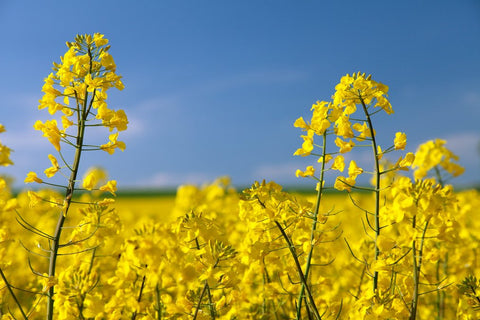
Canola, often little-known to the general public, holds a place of pride in Canadian agriculture and in our kitchens. At Ferme Tournevent, we grow it organically, an approach that reflects our values of respect for the environment and the promotion of healthy foods. Let's discover together its origin, how it differs based on production methods, its benefits, and the agricultural practices that make it unique.
Origin and history of canola
The term "canola" comes from the contraction of Canadian Oil Low Acid. In the 1970s, Canadian researchers selected a variety of rapeseed with reduced levels of erucic acid and glucosinolates, making the oil much more digestible and pleasant to the taste. Canola is therefore a plant resulting from traditional breeding, adapted to meet modern dietary needs.
Traditional breeding vs. GMOs: don't confuse them!
Traditional breeding consists of crossing or reproducing plants (or animals) by selecting, generation after generation, the individuals that display the most interesting characteristics: better taste, disease resistance, increased yield, or even a particular color and shape. It is a natural method, used for millennia by farmers and breeders, which has allowed for the development of the great diversity of varieties and breeds that we know today.
For example, think of the hundreds of varieties of apples (such as the Cortland, Honeycrisp, or Gala), or the different colors and shapes of the many varieties of beans, tomatoes, or hot peppers that can be found. In animals, traditional breeding explains the diversity of dog breeds and cat breeds, developed according to criteria sought by breeders (size, temperament, coat color, etc.).
Conversely, genetically modified organisms (GMOs) are created in a laboratory by the direct insertion of foreign genes into the plant's DNA. This method often aims to make the crop tolerant to certain herbicides or resistant to insects, but it also raises environmental and biodiversity concerns.
By opting for organic canola, you are choosing a crop grown using natural agricultural practices, without genetic manipulation, and which is part of a tradition that is more respectful of ecosystems. Although canola originally came from traditional breeding, the majority of canola grown in Canada today is genetically modified (GMO) to resist chemical herbicides.
GMO canola vs. organic canola
Cultivating GMO canola makes weeding easier, but this practice comes with a heavy reliance on synthetic inputs, crop homogenization, and a significant impact on biodiversity.
In contrast, organic canola:
-
🌿 is grown without GMOs or synthetic chemical products,
-
🌾 is part of a crop rotation system that regenerates the soil,
-
💚 promotes biodiversity and preserves natural balance.
This choice requires more rigor and attention in the fields, but it guarantees healthy, sustainable, and environmentally friendly production.
Our agricultural practice: "peanola"
At Ferme Tournevent, we practice a technique called companion planting (or co-culture). In the fields, the organic canola grows in association with yellow peas.
The benefits of this cohabitation are manifold:
-
the pea, being a legume, fixes atmospheric nitrogen and naturally enriches the soil,
-
the canola benefits from this increased fertility,
-
the diversity in the field limits pests and diseases.
This association is so well recognized that it even has a name in English: "peanola" (pea + canola). It clearly illustrates our desire to farm in an innovative and sustainable way.

Winter canola: a promising crop!
At Ferme Tournevent, we also grow winter canola (or autumn canola), a variety sown in late summer that spends the winter in the field and resumes its growth in the spring. This approach has several advantages:
-
Reduces pest pressure by avoiding their peak activity times
-
Effectively competes with weeds thanks to early rooting
-
Protects the soil by providing vegetative cover during the winter
-
Limits the risk of contamination from GMO canola
Furthermore, its spring flowering is a beneficial food source for pollinators such as bees, bumblebees, and butterflies during a period when supply is often limited, before the emergence of other flower sources.
Although winter survival depends on weather conditions and variety choice, autumn canola shows promise for strengthening crop rotations, improving soil health, and integrating harmoniously into our organic practices.
A key step: post-harvest sorting
Once the harvest is complete, a crucial step involves sorting the grains. In co-culture, peas and canola seeds mix naturally. Through sorting, we separate the two crops to maintain the purity and quality of each grain. This step requires precision and expertise, but it guarantees the traceability and added value of our products.
A plant from the vast cruciferous family
Canola belongs to the cruciferous (or brassicaceae) family, the same botanical family that includes cabbage, radish, broccoli... and mustard! It is no wonder that visitors to the fields often confuse canola plants with mustard plants, as their appearance is so similar.
Canola or mustard: how to tell them apart?
-
🌼 The flower: both produce pretty yellow flowers, but those of the canola are more abundant.
-
🌱 The leaf: mustard has foliage that is more serrated and slightly rough to the touch, while canola foliage is broader and smoother.
-
🌾 The stem: canola is generally taller and more branched than mustard.
Uses and nutritional benefits
Canola oil is one of the most widely used in the world, and for good reason: it is healthy, versatile, and economical.
In daily cooking
-
🍳 Cooking: thanks to its relatively high smoke point of 350 °C, it is perfectly suited for sautéed vegetables, grilled meats, or simmered dishes.
-
🥗 Dressings: its mild flavor makes it an ideal base for vinaigrettes, mayonnaises, and marinades.
-
🥖 Baking: it is used in the making of breads, brioches, or bagels, adding softness and suppleness to the dough.

-
🍰 Pastry and desserts: it advantageously replaces butter or other oils in cakes, muffins, and cookies, while reducing the saturated fat content.

-
🍟 Light frying: used for light frying, it allows for crispy food without altering its natural taste.
Nutritional assets
-
🌿 Balanced fatty acid profile: rich in omega-3 and omega-6, it contributes to a balanced diet.
-
❤️ Good for the heart: its high oleic acid content (a monounsaturated fat) helps maintain healthy cholesterol levels.
-
🔬 Source of Vitamin E: a natural antioxidant that protects cells against oxidative stress.
Beyond food
Canola oil is not limited to cooking:
-
🐄 its protein-rich meal feeds livestock,
-
⚡ it is being explored in the production of biofuels,
-
🧴 it is sometimes used in the composition of natural cosmetics and soaps.
In summary, canola oil adapts to almost all culinary uses, while providing nutritional benefits that make it an ingredient of choice, both in households and in the food industry.
Our organic canola oil: available in 2 sizes
500ml bottle
Ideal for daily use in the kitchen, the 500 ml bottle is perfect for your vinaigrettes, marinades, stir-fries, or pastries. Its practical format ensures you always have it on hand and can enjoy the freshness of cold-pressed oil, without chemical processing.
4 L format
Designed for cooking enthusiasts, families, or restaurant owners, the 4 L version offers excellent value for money. This economical format allows you to benefit from a superior quality oil in large quantities, while reducing packaging. The 4 L format is equivalent to 8 bottles of 500 ml.
By choosing our organic canola oil, you support local, eco-responsible, and artisanal production, which showcases the richness of our terroir.
In summary
Canola is an oilseed plant that combines innovation, nutrition, and sustainability. In its organic form, it becomes a true ambassador for agriculture that is respectful of the soil, ecosystems, and consumers. At Ferme Tournevent, we are proud to contribute to this vision by growing organic canola that nourishes both the land and the people 🌼


Comments (1)
J’adore vos produits et spécialement votre huile de canola que j’utilise beaucoup en cuisine.
Merci pour votre entreprise bio dans notre région.