
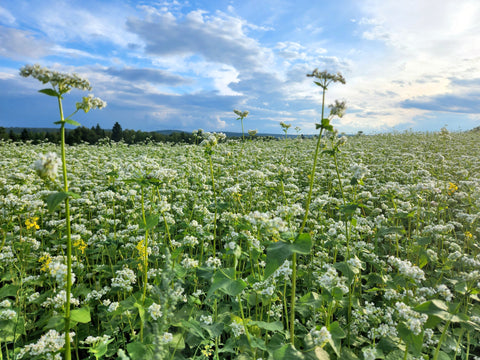
Buckwheat: a precious ally for garden biodiversity
Growing buckwheat (Fagopyrum esculentum) in your garden is about more than just producing edible seeds. This plant offers numerous ecological benefits that promote biodiversity and improve soil health.
A magnet for pollinators and other beneficial insects 🐝🦋
Buckwheat is a honey plant, meaning it produces nectar and pollen in abundance. Its white or pink flowers attract a wide variety of pollinating insects such as:
-
The honey bee (Apis mellifera), which uses its nectar to produce highly fragrant honey.
-
The bumblebee (Bombus spp.), which, thanks to its robust morphology, visits buckwheat flowers intensively.
-
The butterflies and other wild pollinating insects, including certain species specific to certain regions.
By offering an abundant floral resource, buckwheat helps maintain populations of pollinating insects, many of which are in decline due to intensive agriculture and pesticides.
Interesting fact: Unlike many cultivated plants, buckwheat continues to produce nectar even in cool or cloudy weather, which extends the period of pollinator activity.
A refuge and food source for small wildlife 🐦🐞
Buckwheat cultivation also benefits birds and small animals:
-
Seed-eating birds such as sparrows, goldfinches, and buntings are fond of buckwheat seeds, especially at the end of the season.
-
Beneficial insects, like ladybugs and hoverflies, find refuge among the dense foliage of the buckwheat, thus helping to naturally regulate populations of aphids and other pests.
-
Amphibians and small mammals take advantage of the plant cover offered by the buckwheat to hide from predators and find food.
Tip: If you let the buckwheat go to seed, you will feed the birds in winter, thereby contributing to their survival during the cold season.
A natural improvement in soil fertility 🌾
Buckwheat is often used as a green manure in organic farming. It possesses several properties that promote soil health:
-
Improvement of soil structure: its deep roots loosen and aerate the soil, facilitating the penetration of water and nutrients.
-
Fixation of minerals: buckwheat absorbs nutrients like phosphorus and potassium, making them available for subsequent crops.
-
Addition of organic matter: when mowed and incorporated into the soil, it enriches the earth with humus, improving its water retention and fertility in the long term.
Tip: To maximize this effect, you can mow the buckwheat before it goes to seed and lightly bury it in the soil.
A natural anti-weed plant 🚫🌿
Buckwheat is a highly competitive plant that grows quickly and chokes out weeds through several mechanisms:
-
Cover effect: its rapid growth and dense foliage prevent light from reaching the ground, thus limiting the germination of weeds.
-
Allelopathy: it releases chemical substances into the soil that inhibit the growth of other plants, particularly problematic weeds like thistles.
Tip: You can use buckwheat as a transition crop between two main crops to naturally clean your soil of weeds.

A low-maintenance, environmentally friendly crop 🌍
Buckwheat is a hardy plant that grows well in difficult conditions, making it an ecological choice for a nature-friendly garden.
-
No need for chemical fertilizers: it thrives in poor soils and develops without additional inputs.
-
No need for pesticides: it is not very susceptible to diseases and naturally attracts beneficial insects that regulate pest populations.
-
Low water requirements: it tolerates drought relatively well and can be grown without intensive irrigation.
Interesting fact: Buckwheat is not a cereal, but a pseudocereal, related to rhubarb and sorrel. It can therefore be grown even in acidic soils where other plants do not thrive.
A role in preserving local biodiversity 🦔
By integrating buckwheat into a natural garden or permaculture, you promote an ecological balance that benefits many species. It plays an essential role in the conservation of insects, birds, and soil microorganisms.
Tip: Pair buckwheat with other plants that promote biodiversity, such as phacelia, mustard, or clover, for a garden even richer in life.
Conclusion
Growing buckwheat is a simple and effective way to promote biodiversity in your garden. This plant offers a refuge and food source for pollinators, birds, and garden helpers, all while naturally improving soil quality. Low-maintenance, it also helps reduce the use of chemical inputs and fight against weeds.
Whether as green manure, a honey plant, or simple ground cover, buckwheat proves to be a valuable ally for anyone concerned with preserving the ecological balance of their green space.
🌿 So, why not try sowing some at home? 😊



Comments (3)
Merci pour ce bel article sur le sarrazin!
Tellement instructif, concis et facile a comprendre. Il a été cultivé et tellement utile pour nos ancêtres!
J’adore vos produits et surtout la facilité de commander. Votre machine est bien huilée!
Tellement agréable de voir des gens comme vous mettre à contribution nos régions éloignées!
Lâchez pas!
Merci pour ce bel article sur le sarrazin!
Tellement instructif, concis et facile a comprendre. Il a été cultivé et tellement utile pour nos ancêtres!
J’adore vos produits et surtout la facilité de commander. Votre machine est bien huilée!
Tellement agréable de voir des gens comme vous mettre à contribution nos régions éloignées!
Lâchez pas!
Merci pour cette article. C’est toujours très intéressant d’en apprendre d’avantage sur les excellentes huiles Tournevent.